
Industrial - Small Volume Production
Gain unprecedented speed and design freedom with our precision 3D printing and CNC solutions for Industrial Equipment prototyping and production.
Game Changer-3D Printing For Industrial Equipment Manufacturing

Greater Design Freedom
Industrial 3D printing enables complex internal channels, lattice structures, and topology-optimized designs that are difficult or impossible with traditional manufacturing, improving performance while achieving lightweight and function-driven parts.

Part Consolidation & Integration
Additive manufacturing allows one-piece, integrated part production, reducing component count, assembly time, and sealing failure risks while improving overall reliability and material efficiency.

Faster R&D and Production
By eliminating molds and tooling, 3D printing accelerates rapid prototyping and low-volume production, helping equipment manufacturers shorten development cycles and validate designs faster.

Cost-efficient Manufacturing
For high-mix, low-volume, and customized industrial equipment, 3D printing reduces upfront investment and inventory pressure, enabling flexible and cost-efficient production models.
The Future of Industrial Manufacturing
3D printing is no longer just a tool for prototyping. It is fundamentally reshaping the design logic, production workflows, and supply chains of the industrial equipment industry. From high-precision components to large and complex assemblies, industrial 3D printing is becoming a core driver of lightweight design, functional integration, and agile manufacturing.
In the future, additive manufacturing will be deeply integrated across the entire lifecycle of industrial equipment-from rapid prototyping and functional part production to on-demand spare parts and fast response manufacturing. As material performance, printing accuracy, and scalable production capabilities continue to advance, 3D printing will evolve from a supporting technology into a critical production method for industrial applications.
Unionfab delivers reliable and scalable additive manufacturing solutions for industrial equipment through its multi-process industrial 3D printing platforms, comprehensive material and post-processing systems, and engineering-oriented services. We help manufacturers build more efficient, flexible, and future-ready industrial manufacturing systems.
Solutions for Industrial Small Volume Production
3D Printing Applications in Industrial
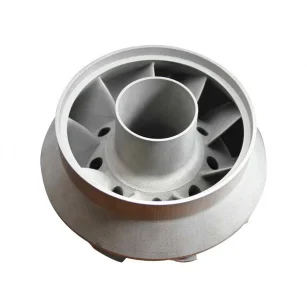
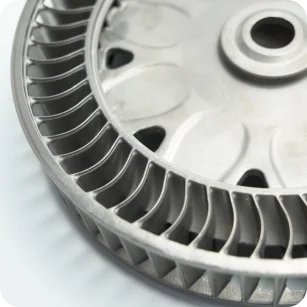
 Core Functional Components: Heat exchangers, impellers and turbines, manifolds, custom connectors.
- Tooling, Fixtures & Manufacturing Aids: Assembly fixtures, inspection jigs, robotic end-effectors.
- Functional Prototypes & Engineering Validation: Pump prototypes, energy equipment validation parts, functional test components.
- Industrial Spare Parts & Low-Volume Production: Obsolete equipment parts, custom replacement components, low-volume customized parts.
- Lightweight & Structural Optimization Components: Topology-optimized brackets, honeycomb and lattice structures, robotic system components.
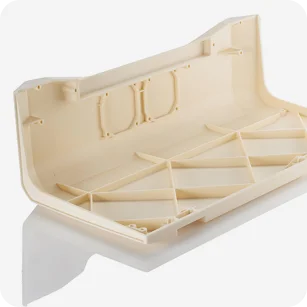
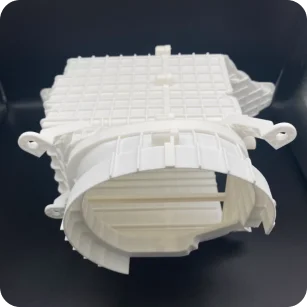
- Molds, Silicone Tooling & Forming Assistance: Industrial enclosures, functional housings, industrial electronic components.




Trusted by the World's Top Industrial Engineers and Designers
Heavy Machinery
Machine Tools
Industrial Robotics
Industrial Products and Services
Petrochemicals
Chemicals
Specialty Materials
Nano Materials
Power Plants
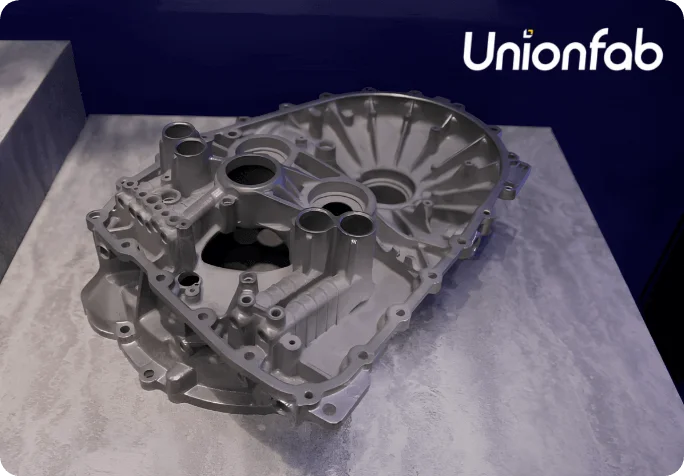
Metal 3D Printing for Lightweight Industrial Equipment | Unionfab
To address challenges such as excessive weight, limited heat dissipation, and long development cycles in high-performance equipment for the energy, automotive, and aerospace industries, Unionfab leverages SLM metal 3D printing combined with integrated structural and thermal management design. This approach enables the one-step fabrication of complex internal cooling channels while maintaining high strength and reliability, significantly improving component performance and accelerating product iteration.
- Development cycle reduced by ~60%, compared with traditional casting and CNC machining.
- Dimensional accuracy within ±0.05 mm, consistently maintained across multiple builds.
- Enhanced reliability confirmed, through thermal cycling and durability testing, with no structural degradation observed.
- Overall prototyping and tooling costs reduced by ~40%, enabling rapid iteration from concept to validation.

The Main Advantages of 3D Printing in the Industrial Industry
- Integrated Manufacturing of Complex StructuresIndustrial 3D printing enables the one-piece fabrication of complex internal cavities, cooling channels, and integrated structures, reducing welding and assembly steps while improving overall strength and operational stability of industrial components.
- Improved Part Performance and Lightweight DesignThrough design optimization and lightweight structures, metal 3D printing improves part strength, fluid flow efficiency, and thermal management, delivering higher performance under real industrial operating conditions.
- Faster Development and Shorter Lead TimesWith no tooling or molds required, additive manufacturing allows rapid prototyping and direct production of functional parts, significantly shortening the development and delivery cycle of energy and industrial equipment.
- Broad Range of Industrial Metal MaterialsSupporting stainless steel, aluminum alloys, titanium alloys, and high-temperature superalloys, metal 3D printing meets demanding requirements for high strength, heat resistance, and corrosion resistance in industrial applications.
- Cost-Effective for Low-Volume ProductionFor non-standard, low-volume, and customized industrial parts, metal additive manufacturing reduces upfront investment and manufacturing complexity, improving overall cost efficiency.
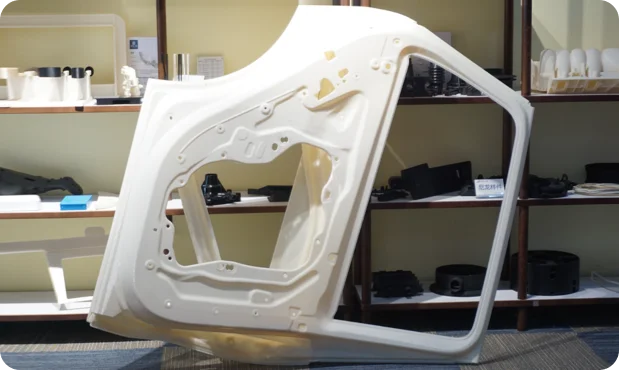
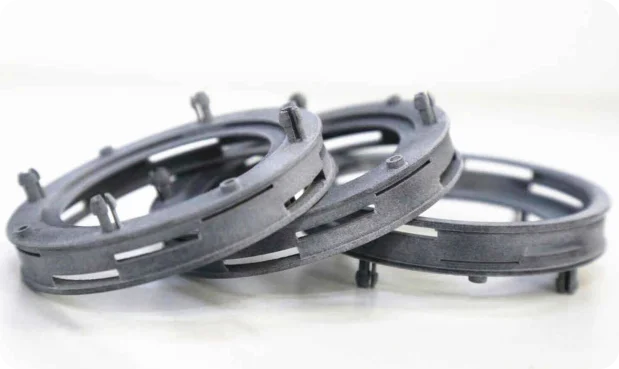
Industry Standards and Compliance
In industrial manufacturing, 3D printing is not only about speed and performance-it must also meet strict industry standards and compliance requirements. We are ISO 9001 certified and have established a full-process quality management and traceability system covering raw material control, process parameter validation, and final inspection. This ensures industrial-grade accuracy, strength, and consistency for additive manufacturing parts. Through standardized production and continuous optimization, we enable customers to safely and reliably apply industrial 3D printing from design validation to low- and high-volume production.Overview of Common Manufacturing Processes
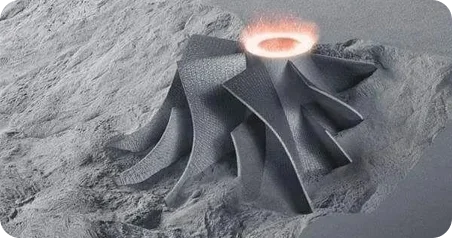
Metal 3D Printing Service
Selective Laser Melting (SLM): Delivering high dimensional accuracy and high part density, making it ideal for functional end-use metal parts.
Common Materials: Stainless Steel (316L, 17-4PH), Aluminum Alloy (6061, AlSi10Mg), Inconel 625, Titanium Alloy (Ti6Al4V) etc.
Specific Applications: Industrial equipment structural parts; energy equipment components; tooling and fixtures.
.png?x-oss-process=image/format,webp/quality,Q_85)
Plastic / Polymer 3D Printing Service
Selective Laser Sintering (SLS): Requires no support structures and is ideal for complex geometries and functional plastic parts, offering excellent strength and dimensional stability.
Common Materials: Nylon 6, 11, 12 (glass-filled), Nylon 12-FR, TPU etc.
Specific Applications: Industrial equipment housings and brackets; low-volume plastic parts; functional testing components.
.png?x-oss-process=image/format,webp/quality,Q_85)
Thermoplastic 3D Printing Service
Fused Deposition Modeling (FDM): Offers low cost and a wide range of material options, making it ideal for rapid production of large-scale tooling and structural parts.
Common Materials: PETG, PC, ASA, Stratasys ULTEM 9085, PC-FR(UL94-V0), PA6-GF, PA6-CF, Nylon 12 Carbon-filled etc.
Specific Applications: Tooling and fixtures; auxiliary tools; equipment protective covers.
.png?x-oss-process=image/format,webp/quality,Q_85)
Resin 3D Printing Service
Stereo Lithography Apparatus (SLA): Delivers excellent surface finish and high detail accuracy, making it ideal for high-precision prototypes and small structural parts.
Common Materials: Standard Resin, High Detail Resin, Nylon-like Resin, Tough Resin etc.
Specific Applications: Functional equipment prototypes
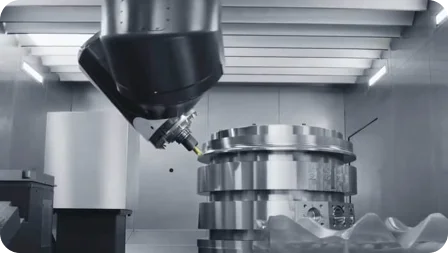
CNC Machining Service
CNC Machining: Uses computer-controlled equipment to perform high-precision cutting on metals and engineering plastics. It ensures excellent dimensional stability, superior surface quality, and is ideal for industrial components with tight tolerance requirements.
Common Materials: CNC Engineering Plastics, CNC Alloys (Aluminum, Stainless Steel, Copper, Bronze, Brass etc.), CNC Ceramics, CNC Rubber etc.
Specific Applications: High-precision structural parts for industrial equipment; mechanical connectors.
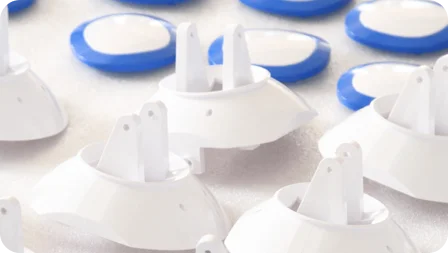
Silicone Molding Service
Silicone Molding: Silicone molding creates flexible molds from 3D-printed or CNC prototypes, enabling rapid casting of small-batch plastic parts. This method offers low cost, fast turnaround, and high repeatability.
Common Materials: PC-like, Nylon-like, PMMA-like, Flame resistance ABS, Heat-resistant 6160 etc.
Specific Applications: Industrial equipment enclosures and panels; functional test plastic parts; rapid prototyping of custom components.
Key Success Factors

Design Optimization
We provide component design optimization services, including topology optimization, lightweight design, and manufacturability analysis, to achieve the optimal balance between performance and cost.

Expert Support
We have an experienced team of engineers that provides comprehensive technical support, including material selection recommendations and process guidance, to ensure smooth project progress.

Rapid Prototyping
We support rapid prototyping and small-batch custom production within 3-7 days, helping customers shorten R&D cycles and accelerate product iteration.

Project Collaboration
From requirement analysis and solution design to production and post-processing, we provide full-process project management to ensure transparency and control at every stage, while maintaining efficient communication with the customer's R&D team.

Quality Assurance
All components undergo rigorous testing and comply with ISO, CE, and RoHS standards. We also provide comprehensive after-sales support to ensure customers have complete peace of mind.
Frequently Asked Question(FAQ)
For industrial equipment applications, we offer a wide range of metal and engineering-grade 3D printing materials, including stainless steel, aluminum alloys, titanium alloys, and nickel-based superalloys, as well as high-performance plastics such as PA12, PA6, and PEEK. These materials are ideal for high-strength, high-temperature resistance, corrosion resistance, and long-term industrial use.
Start Your Industrial Equipment Project Today
Accelerate every stage from design validation to small-batch production with cutting-edge 3D printing technology.
Get Instant Quote
